A-OFDM Abdou-Orthogonal Frequency-Division Multiplexing
A bare-metal physical layer overhaul that weaponizes multipath interference, eliminates protocol overhead, and punches through concrete walls at 2.4 GHz — achieving sub-millisecond wireless latency without violating legal power limits.
Wi-Fi Went Wrong After 802.11n
The original W-OFDM math — invented right here in Calgary by Hatim Zaghloul and Michel Fattouche — was bulletproof. It powered clean, efficient 802.11a/g wireless that simply worked. Then the IEEE bolted on massive MIMO arrays, bloated MAC-layer scheduling, and brute-force guard intervals. Modern Wi-Fi 6/7 and 5G NR waste up to 20% of their licensed spectrum broadcasting empty buffer zones, force devices to beg the router for permission before transmitting a single byte, and treat every wall bounce as destructive noise to be filtered out.
A-OFDM strips all of that out. Designed by Abdou Traya at WestNet, A-OFDM is not an extension or a patch — it is a clean-sheet physical layer architecture that re-examines the radio physics from first principles. Instead of fighting the environment, A-OFDM cooperates with it.
Abdou Traya — From Calgary's First Wi-Fi to A-OFDM

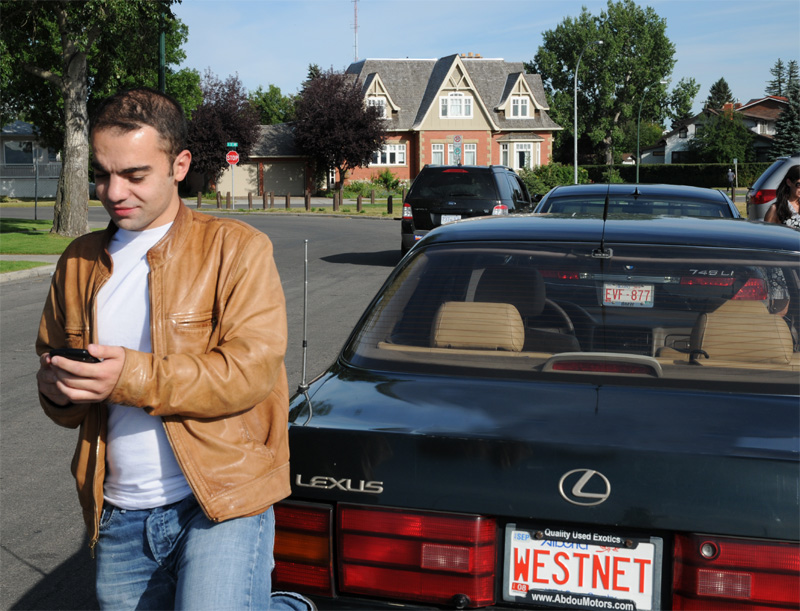
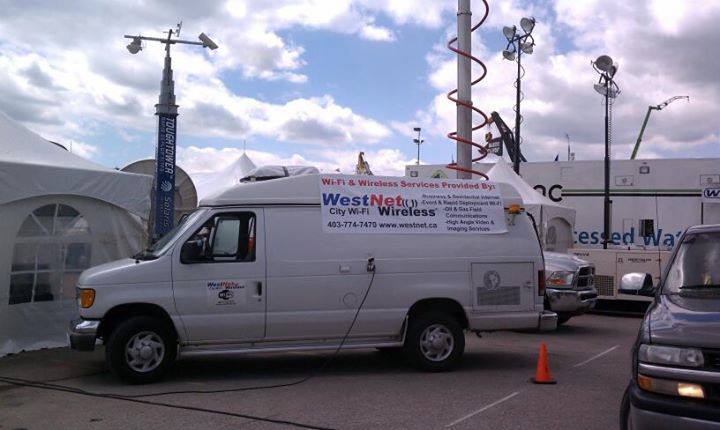
Abdou Traya founded WestNet in Calgary in 1998 at age 16 and built the city's first community Wi-Fi network in 2001 — years before municipal wireless was a concept anywhere else in Canada. By 2006, WestNet launched Calgary's first city-wide commercial Wi-Fi network in partnership with WiLAN, the original inventors and patent holders of W-OFDM. By 2010, WestNet had 17,500 subscribers on a self-funded, debt-free network covering 20 km² of Calgary.
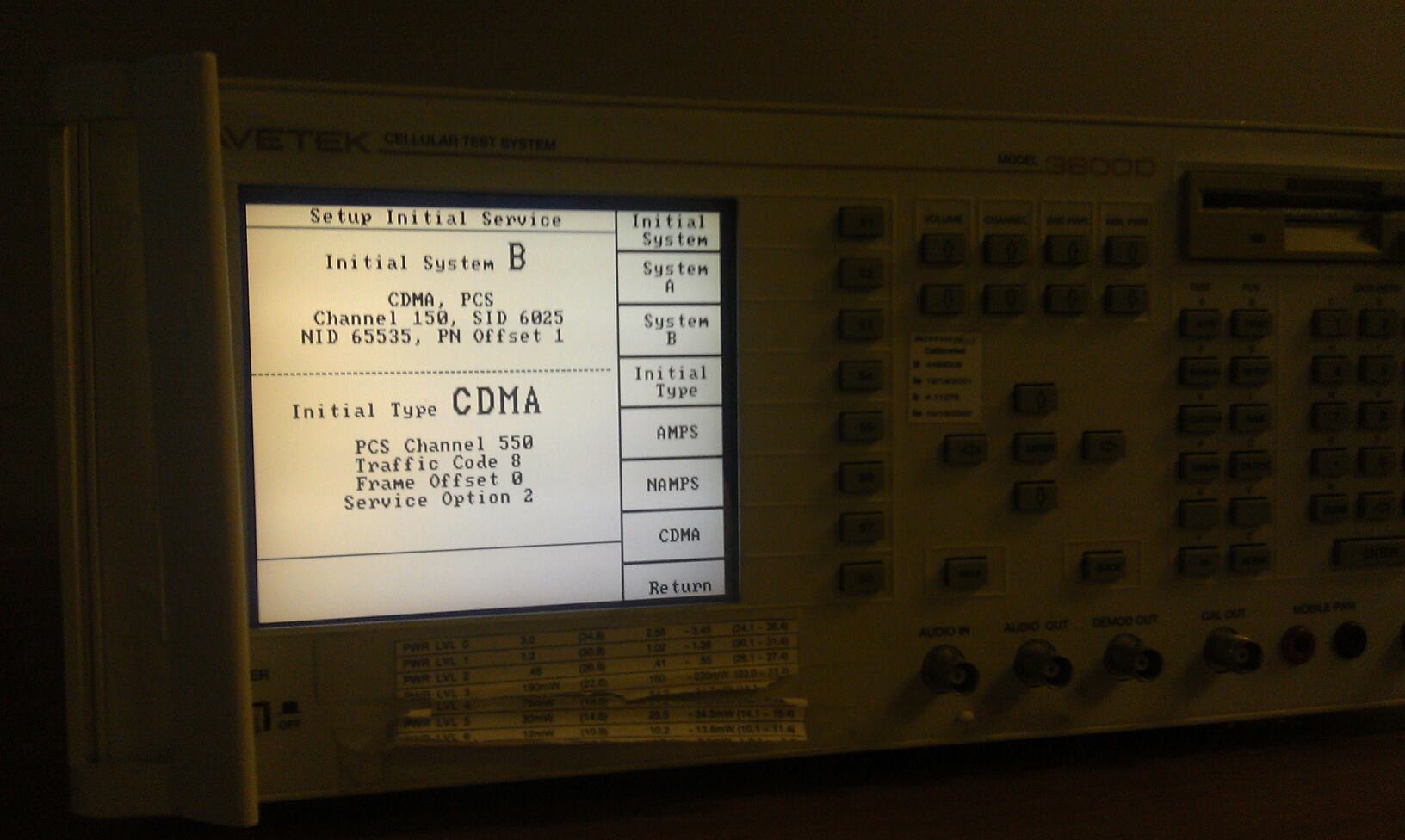
A-OFDM is not an academic exercise. It comes from 25 years of operating real wireless infrastructure on real streets — watching signals die in stairwells, debugging multipath in concrete parkades, and running CDMA EV-DO base stations alongside Wi-Fi on the same towers.

The MoCA Antenna Experiment That Started It All
In 2009, Traya took MoCA (Multimedia over Coax Alliance) cable bridge adapters — devices designed to run OFDM networking over coaxial cable — and strapped external antennas to their coax ports. He was radiating coax-native OFDM at ~1.4 GHz over the air, building a homebrew L-band wireless bridge out of consumer cable hardware.
MoCA was built for a brutally noisy environment: coaxial cable full of cable TV signals, splitter reflections, and impedance mismatches at every connector. Its OFDM had aggressive forward error correction, per-link channel probing at setup, and was literally hardened to survive heavy multipath — because coax cable reflections are physically identical to room-bounce multipath in wireless.
The experiment proved the core principle that would become A-OFDM: modulation designed to embrace reflections rather than fight them outperforms standard Wi-Fi in real-world conditions. MoCA's per-link channel probe is A-OFDM's one-time fingerprint. MoCA's multipath-hardened OFDM is A-OFDM's CIC. The 2009 coax hack is the DNA of this architecture.
The Four Pillars of A-OFDM
Conjugate Interference Cancellation (CIC)
Every legacy system treats multipath echoes as destructive noise. A-OFDM inverts the paradigm: for every data symbol S, the transmitter fires a mathematically conjugate partner S* delayed by exactly the room's measured echo time Δt. When both arrive at the receiver, the echo of S and the direct path of S* align in perfect phase — they sum constructively. The room's walls become passive signal amplifiers.
UHF-Style PSD Wall Penetration
Legacy Wi-Fi spreads 1W across 20 MHz = thin, easily absorbed energy. A-OFDM compresses the synchronization control pulse into a 50 kHz narrowband subcarrier — concentrating the same legal power into a slice 400× denser. This “armor-piercing” burst punches through multiple concrete floors, wakes the receiver, maps the multipath geometry, and lets the wideband CIC payload follow behind it.
Quiet Ramp — Zero-Preamble Sync
Every Wi-Fi and 5G packet wastes 40–100 μs broadcasting a training preamble before payload moves. A-OFDM kills it entirely — the conjugate pair structure is the synchronization mechanism. The receiver locks phase from the first symbol. Payload transmission starts at microsecond zero.
Grant-Free Asynchronous MAC
Legacy networks force devices to send a scheduling request, wait for a resource grant, then transmit — adding 10–30 ms of pure administrative lag. Because CIC signals are constructively focused by each device's unique channel fingerprint, A-OFDM nodes transmit the microsecond data is ready. No handshake. No queue. No permission.
Legacy Wi-Fi vs A-OFDM Signal Behavior
Observe how legacy wideband energy dissipates through walls, while A-OFDM's narrowband control pulse punches clean through — then the CIC payload follows using constructive multipath.
Legacy Wi-Fi — 20 MHz Wideband
A-OFDM — 50 kHz UHF Punch
A-OFDM Transmission Pipeline
From raw payload to sub-millisecond delivery — the complete signal path with zero scheduling requests, zero preamble, and zero wasted guard intervals.
Raw Payload
Application data enters baseband DSP
CIC Pair Gen
Symbol S + conjugate S* with Δt from fingerprint
UHF PSD Punch
50 kHz narrowband control burst fires first
Multipath Channel
Walls & surfaces constructively focus energy
Receiver Lock
Zero-preamble phase lock. Payload at μs 0
A-OFDM PSD Penetration Simulator
Adjust transmit power and wall count. Toggle between legacy Wi-Fi and A-OFDM to see the UHF-style PSD advantage in real time.
Live RF Propagation Engine
Drag the sliders and switch modes — the canvas and telemetry update in real time.
A-OFDM vs Legacy Protocols
| Metric | Standard Wi-Fi / 5G | A-OFDM (Abdou Traya) |
|---|---|---|
| Air-Interface Latency | 30 – 50 ms | < 1 ms |
| Multipath Behavior | Destructive — signal fading | Constructive — CIC amplification |
| Channel Feedback | Continuous CSI every slot (ms) | One-time fingerprint (min/hrs) |
| Preamble Overhead | 40 – 100 μs per packet | Zero — Quiet Ramp self-sync |
| Guard Interval (CP) Waste | Up to 20% of bandwidth | 0% — CIC replaces CP |
| MAC Access | Scheduled — request/grant queue | Grant-free async injection |
| Wall Penetration (Control) | Poor — 20 MHz spread thin | 400× PSD — UHF-style punch |
| Power Amplifier Efficiency | Backed off ~30% for PAPR spikes | Near-saturated — flat amplitude |
| Synchronization Hardware | GPS-locked atomic clocks | None — async by design |
Power, Range & Throughput — Same Hardware, Different Physics
A-OFDM does not increase transmit power. It concentrates and shapes the same legal wattage 400× more efficiently on control, and reclaims 20% wasted spectrum on payload. Here is what that means on real hardware.
| Metric | WRT54G (802.11g) 12V / 1A = 12W |
WRT3200ACM Stock 12V / 3A = 36W |
WRT3200ACM + A-OFDM 12V / 3A = 36W |
|---|---|---|---|
| TX Power | ~17 dBm | ~22 dBm | ~22 dBm (same) |
| Control PSD (W/Hz) | 5.0×10⁻⁸ | 5.0×10⁻⁸ | 2.0×10⁻⁵ (400×) |
| Real Throughput (LOS) | ~25 Mbps | ~180 Mbps (2.4G) | ~220 Mbps |
| Through 1 Concrete Wall | ~8 Mbps | ~90 Mbps | ~220 Mbps (+CIC gain) |
| Through 3 Concrete Walls | Dead zone | ~15 Mbps or dead | ~60–80 Mbps |
| Through 5 Walls / 3 Floors | Dead zone | Dead zone | ~15–25 Mbps |
| Air-Interface Latency | ~8–15 ms | ~5–12 ms | < 1 ms |
| Efficiency (Mbps/W) | ~2.1 | ~5–17 | ~17–22 |
| Guard Interval Waste | ~20% | ~20% | 0% |
| Preamble Overhead | 40–100 μs | 40–100 μs | 0 μs (Quiet Ramp) |
Projected A-OFDM values based on CIC constructive multipath gain (+3 to +6 dB effective), zero cyclic prefix bandwidth recovery (~20%), Quiet Ramp preamble elimination, and 400× PSD concentration on narrowband control burst. Same 12V/3A power adapter — same total EIRP — fundamentally different signal physics.
A-Revision Baseband Requirements
A-OFDM cannot be deployed as a firmware update to existing Wi-Fi chipsets — the physical layer is fundamentally different. The “A-Revision” baseband requires:
- CIC Conjugate Pair Generator: Hardware-accelerated DSP block that computes S* and applies Δt delay in real time per-symbol.
- UHF PSD Narrowband Injector: RF front-end capable of switching between 50 kHz control burst and wideband payload within microseconds.
- Quiet Ramp Synchronizer: Receiver-side phase-lock loop that extracts timing from conjugate pair structure without requiring a training preamble.
- One-Time Fingerprint Engine: Channel impulse response measurement block that captures delay spread and phase rotation at connection setup.
- Linear Layer Processing Unit (LLPU): Pre-IFFT amplitude shaping module that flattens PAPR peaks, enabling low-cost saturated power amplifiers.
Initial prototyping targets Software Defined Radio (USRP) and FPGA platforms. Production silicon (ASIC) follows successful FPGA validation.
From Lab to Standard
Phase 1 — SDR Simulation
Deploy USRP SDR on Linux server. Write DSP algorithms in C/Python to generate S/S* conjugate pairs. Prove Quiet Ramp works without standard preamble.
Phase 2 — IP Protection
File utility patents on Quiet Ramp zero-preamble sync, grant-free MAC with one-time fingerprinting, and UHF PSD narrowband control signaling. View patent application →
Phase 3 — FPGA Prototype
Port SDR code to high-speed FPGA. Deploy A-OFDM nodes on WestNet internal network. Benchmark sub-millisecond latency against 802.11ax gear.
Phase 4 — Silicon & Standard
Design custom ASIC A-OFDM baseband modem. Deploy proprietary ultra-low-latency enterprise networks or license the PHY/MAC to IEEE for Wi-Fi 8.
A-OFDM — Built in Calgary
Interested in the A-OFDM architecture, licensing, or partnership? WestNet is developing the next generation of wireless from the city that invented W-OFDM.
Patent Application → Contact WestNet → All Innovations →